Fanfic With No Favorites or Follows Are They Bad to Read
Or, What is Fanfiction, How is information technology Relevant, and Why is information technology Illegal to Print it (Publicly or Privately) Using Lulu?
In the year 2021, with the always-growing popularity of the cyberspace, fandom, and other aspects of nerd-culture that were previously kept behind closed doors, you have probably heard of fanfiction.
Most notoriously, the best-selling volume of the last decade (no, really) Due east.L. James' Fifty Shades of Grayness started its life as Twilight "AU (alternate universe)" fanfiction. Similarly pop, though more than tangentially related, is Anna Todd's Afterwards series, formerly I Management "OC (original character)" fanfiction. Mayhap you remember hearing fizz about Cassandra Clare'southward The Mortal Instruments series originally being Harry Potter fanfiction, dorsum in the twenty-four hour period. Or, if you're really an internet veteran, you may recall reports of Anne Rice suing fanfiction authors every bit far back as the nineties and early aughts.
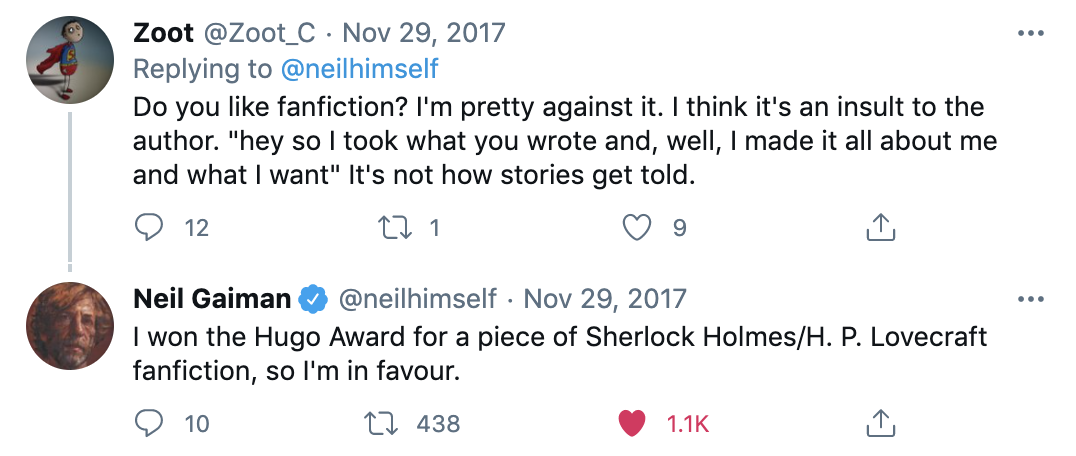
Unfortunately for fanfiction – and fanfiction authors and readers – information technology tends to only make the news for scandalous reasons. Which is a shame, because fanfiction can exist an incredible outlet for inventiveness, catharsis, and community. And while information technology has get more popular, fanfiction authors still take enough of hurdles left to leap. In 2019, Archive of Our Own, an online fanfiction database, won the Hugo Award for Best Related Piece of work, which was kind of a big deal (yes, I am a Hugo Laurels winner, thanks so much). And as more and more published authors speak out about their own fanfiction history, we find that for every Anne Rice, there is a Neil Gaiman:
Just What Is Fanfiction? And Why Practise People Write Information technology?
I'thou then glad you lot asked. Fanfiction, for the uninitiated, is the process of writing original stories using the characters, plot points, and universes already invented by other creators. Fanfiction – as well known equally fanfic, or only fic – can take many forms, and serve many purposes, often dependent on the original source textile in question.
In order to really talk about fanfiction, there are probably a few terms you need to know:
- Canon – the details accepted as "officially" role of the original source fabric.
- Alternate Universe / AU – a story that takes place in a different "universe" than the one that the canon plot exists in.
- Catechism Compliant – fanfiction that fits into the pre-existing universe, unremarkably episode tags or fics that are continuing a plot point that has not been resolved by canon yet.
- Canon Divergent – fanfiction that, different an AU, originated in the source universe but eventually deviated from the catechism plot. Canon compliant fics can eventually go canon divergent.
- Aircraft / Transport – rooting for two characters to air current upward in a romantic human relationship together or otherwise acknowledge their attraction to each other.
- A "ship," as opposed to the action "shipping," is a popular pairing of characters that fans are invested in seeing together. Oft represented by a slash between the ii grapheme'due south names or portmanteaus of the ii characters, ie. Braime (Brienne/Jaime from Game of Thrones), Destiel (Dean/Castiel from Supernatural), or Supercorp (Kara Danvers/Lena Luthor from Supergirl).
- Episode Tag – can also be referred to as codas or missing scene fics, episode tags are short fics that are written expressly to explore, aggrandize upon, or react to a specific moment in an episode or chapter.
Mayhap the easiest way to answer the question "what is fanfiction" is to answer the question "why is fanfiction?" At its most basic level, fanfiction exists to fill up a void left by canon. What that void is, specifically, can vary dramatically, but most (not at, just an overwhelming majority of) fanfiction can be boiled down into one of three major intents:
Speculation on What'south to Come
That cliffhanger was brutal, wasn't it? And now you lot have to expect, like, at least another year before you tin observe out what happens next? Not in fanfiction, you don't. When a series is incomplete and fans are impatient for the side by side installment, ambitious authors will try to explore what they think will happen next in the story.
Speculation on "What If"
What if Luke had been raised as the Prince of Alderaan and Leia raised by moisture farmers on Tatooine? What if none of the Avengers had superpowers and instead were all students at a Mean-Girls-esque high school? What if the Stranger Things kids went to Hogwarts (seriously, I challenge you to find any fandom that doesn't have at to the lowest degree one Hogwarts AU)? Speculative alternating universe – AU – fanfiction primarily explores what would happen if we took beloved characters and dramatically (or subtly) changed their circumstances.
Speculation on What Could Happen (or Could Have Happened)
The most catch-all of these 3 buckets, what could happen (or could have happened) differs from the other ii in the content that it explores. While "what's to come" is almost e'er canon-compliant (until, of course, information technology gets replaced past bodily canon, or "jossed") and "what if" is almost always alternate universe, "what could happen" is usually catechism divergent or, if y'all want to get technical, canon adjacent. "What could happen" fics can include things like episode tags that explore a scene that happened off-screen, the aftermath of a Large Event, or an exploration of how That Transport That Everyone Ships finally gets together. "What could happen" fics, in particular, tend to delve into the graphic symbol-driven, emotionally-driven plot moments that oft get lost in big, ensemble casts and action-driven canon.
Exploring the Existent Why
Ultimately, the existent "why" of why practise people write fanfiction is difficult to answer. I believe if you lot polled 100 fanfiction writers and readers and asked them why they write/read fanfiction, you would go 100 different answers. In fact, I recall you lot could inquire i writer why they write/read fanfiction and you would become a different answer for every distinct fandom they participate in.
Sometimes I plow to fanfiction when I think showrunners take betrayed proficient characters with mediocre plots. Sometimes I turn to fanfiction considering I know the ships I ship will never be canon, but at to the lowest degree this way I'll go some kind of satisfaction. Sometimes it'southward considering I beloved a set up of characters so much that I'k not willing to part with them once catechism has run its course. And hey, honestly, sometimes it'southward because it's a whole lot easier (and cheaper) to find attainable reading material for free online when I'm in the mood for a 10k injure/comfort episode tag where at that place's but one bed.*
*a x,000-word fic where the two characters I ship wind up comforting each other after the events of a particular episode or chapter, presumably in a scenario where they are forced to share a bed/room for Reasons.
How is Any of This Relevant?
Fanfiction in Literature
Fanfiction has always been relevant in literature, long before information technology was even recognized equally its own medium. Don't believe me? The Divine Comedy is self-insert Bible fanfiction. Virgil was deputed by Augustus Caesar to write The Aeneid as a spin-off fic from The Iliad, exploring the minor character Aeneas. Pretty much any version of the King Arthur legend that came later on Le Morte d'Arthur, including, of course, The Once and Future King, is someone else's hot accept on Arthurian fable.
Peradventure most famously of all (simply secretly so): The Three Musketeers. According to the introduction written by Alexandre Dumas himself, Dumas was inspired while reading Mémoires de Monsieur d'Artagnan, a novel by Gatien de Courtilz de Sandras, and wanted to explore what other adventures those characters got up to.
One could too debate that retellings, origin stories, and modernizations are as well a form of speculative fanfiction. Actually, what is Clueless if non the respond to the question "what if Emma took place in Beverly Hills in the nineties?" What is Sherlock, or the more recent Enola Holmes, if not speculative "what if" of Sir Arthur Conan Doyle's famous detective stories? What on Earth does Leonardo da Vinci have to practise with Cinderella? Absolutely cipher, but apparently someone decided that a crossover fic (combining ii unrelated canons or characters into i story) was necessary and Ever After was built-in. How, exactly, is maxim "I'm going to take the Justice League and write them all every bit normal humans" any different than Percy Jackson, American Gods, or the hundreds of other books exploring the gods of various pantheons? And don't even get me started on Hamilton or Harry Potter and the Cursed Child.
But across the point that fanfiction has e'er been relevant in literature, these days information technology has get more intrinsically tied to publishing than e'er before. And I'm non fifty-fifty talking most the fact that authors now get deputed to write officially-sanctioned fanfiction for major franchises like Star Wars, the Marvel Cinematic Universe, and D.C. Icons.
Fanfiction in Publishing
While fanfiction has existed long before the internet, its popularity has undeniably skyrocketed since online databases like Archive of Our Ain and its predecessor Fanfiction.Net have made it that much more accessible. And with the rise of epic series that accept years to come to their canon conclusions – and often leave many stones unturned – more and more young writers turned to fanfiction in the gaps between Harry Potter books or Game of Thrones seasons.
The thing is, reading fanfiction is a gateway drug. You read enough fic and you're jump to become inspired to write your own. You lot write plenty of your own and you start developing your craft, practicing your style, flexing your writing muscles. Information technology'south a short jump from a "what if" fic with a highly original plot that just happens to use existing characters to only diving right into that original plot with original characters. And suddenly, before yous know it, there goes a whole generation of former fanfiction writers that are now publishing fantastic works of original fiction.
More and more fiction authors are speaking up well-nigh getting their start in fanfiction. Multi-time New York Times bestseller Christina Lauren is a romance-writing duo that got their start writing Twilight fanfiction. Award-winning Sci-Fi Fantasy writer Naomi Novik isn't just open up well-nigh her history writing fic – she'south likewise partly responsible for Archive of Our Own, i of the largest fanfiction databases on the internet. Marissa Meyer, Cassandra Clare, and Rainbow Rowell – all prolific YA authors – have shared their love of fanfiction openly and in their work. Neil Gaiman, of course, refers to his A Study in Emerald in the tweet shared above. The Outsiders writer S.E. Hinton has tweeted most writing Supernatural fanfiction, and The Magicians author Lev Grossman has openly posted his How to Train Your Dragon fic on his own website.
All of this to say, really, merely this: fanfiction already exists in publishing. And information technology has already been inspiring writers for years and years, and probable will continue to exercise and so for years and years to come.
How is Any of This Relevant to Self-Publishing?
Fanfiction and self-publishing – particularly the "no-minimums impress-on-demand" manner self-publishing we practice – have both seen a rise in popularity over the final few years, then it makes sense that they would somewhen take hold of air current of each other. In item, we have seen an increment in authors and readers publishing fanfiction – whether for public resale or only for individual employ – using Lulu.
Unfortunately, whether you're publishing your own fanfiction to sell on our bookstore or ordering a printed copy of your favorite fic for your bookshelf, using Lulu to print fanfiction is illegal.
Selling Fanfiction Through the Lulu Bookstore
For as prevalent every bit it is in and around modernistic publishing, fanfiction has ever had i major downside: it skirts the edges of copyright infringement. Before long, publishing fanfiction online is considered legal in the Usa because it is "noncommercial distribution." In other words, when you post fanfiction on AO3 or another advert-supported, free-to-employ site, nobody is making any coin from the bodily intellectual holding itself.
However, once a piece of fanfiction has been published for sale on the Lulu bookstore (or whatsoever other online retailer, for that matter) it has crossed the line into "commercial distribution," which is copyright infringement and is illegal. In other words: if yous are selling, for-profit, derivative work of copyright-protected material, y'all are breaking the law.
The exception to this rule is work inspired by any slice of media that is a part of the public domain. Published work tin can enter the public domain one time the copyright has expired (or, of form, if it was never copyrighted in the beginning place).
Because Lulu is an open up platform for any and all authors to publish their work, nosotros exercise not accept filters that review content before information technology is published to our bookstore. Still, should we come across content that breaks copyright law, we will immediately remove it from our site and cancel whatever awaiting orders.
Printing Fanfiction For Individual Apply
This is arguably the most often misunderstood office of copyright infringement, at least for how it relates to fanfiction and self-publishing. There has been a recent uptick in fanfiction readers ordering individual impress copies of their favorite works to add to their book collections.
Equally both a long-time fanfiction writer and a reader with an absurd book collection, I completely empathise this desire. I would probably cry if a reader ever told me they wanted a print re-create of my fanfiction, and I could hands make full a whole bookcase with beloved favorites that I read and reread. Only unfortunately, printing copyrighted work for private use is still copyright infringement.
What it all boils down to is turn a profit. If anyone other than the copyright owner makes a profit off copyrighted work, without the permission of the copyright owner, it is copyright infringement. And even if you are printing the piece of work for private utilise, not selling it, we are even so making money off information technology. Lulu makes a small turn a profit off every book we print, which ways even a book printed for your own personal use is not completely turn a profit-less.
Also, non for nothing, but some interpretations of copyright law suggest that fanfiction authors themselves accept a sure amount of copyright merits over their intellectual belongings. So really, if you're post-obit the letter of the alphabet of the constabulary, if you're press fanfiction that wasn't written by y'all, you lot're committing 2 dissever types of copyright infringement at the same fourth dimension.

So What Can I Print?
If you're publishing any kind of derivative fiction – fanfiction, retelling, modernization, gender-swap, alternate universe, etc. – that is inspired by source material within the public domain, you lot are free to impress and sell (or but print) your work.
If you are printing any kind of derivative fiction – fanfiction, retelling, modernization, gender-swap, alternating universe, etc. – where the original work is however protected by copyright, yous can not impress or sell your own copies.
If you are uncertain about whether or non your work is infringing upon copyright law I would highly encourage you to look into the origin and copyright details of the original inspiration for your volume. A quick Google search should turn up the virtually up-to-date data. We've likewise talked about Copyright Police force Nuts for Authors on the blog earlier (though that does touch on more upon protecting your ain piece of work).
Ultimately, I will abet for fanfiction for the rest of my life, both professionally and personally. I think it's an incredible outlet that inspires customs, creativity, and talent. I think it'due south an irrefutable office of both literary history and the modern publishing industry, and I think information technology has a long hereafter of staying relevant. I hope to see more and more authors owning their origins as fanfiction writers and leaning into their existing online communities when they branch out into exciting new original fiction opportunities. However, when it comes to using impress-on-demand to sell or print copies of your favorite fics: don't.
Source: https://blog.lulu.com/what-is-fanfiction-and-why-does-it-matter/
0 Response to "Fanfic With No Favorites or Follows Are They Bad to Read"
ارسال یک نظر